

Jane Badger Books
Diana Pullein-Thompson: Riding with the Lyntons (eBook)
Diana Pullein-Thompson: Riding with the Lyntons (eBook)
Couldn't load pickup availability
Share
As I looked at the small sheltered paddock, my thoughts turned to the pony of my imagination ...
Lesley Warren's parents have decided to move to the countryside after years of city living. There's a pony promised in her future, and perhaps best of all for only-child Lesley, a host of new friends in the irrepressible Lynton clan, who live just up the lane from Sparrow Cottage. She can’t believe her luck when at last she gets to meet them.
But when a terrible accident happens to one of the Lyntons' ponies, Lesley is blamed. The Lyntons close ranks on her, and even a pony of her own can't blot out her unhappiness. What will Lesley do? Will they ever forgive her?
Will she ever ride with the Lyntons again?
Hunting was legal when this book was written in the 1950s, and it includes hunting scenes
Delivery time: eBook download links are sent immediately when you complete your purchase
Page length: 202
Original publication date: 1956
How do I get my book?
How do I get my book?
There's a link to download in your confirmation email. If you need help, the email from Bookfunnel, who handle our delivery, will walk you through downloading the file that works best for you.
How do I read my eBook?
How do I read my eBook?
You can read the ebooks on any ereader (Amazon, Kobo, Nook), your tablet, phone, computer, and/or in the free Bookfunnel app.
Read a sample
Read a sample
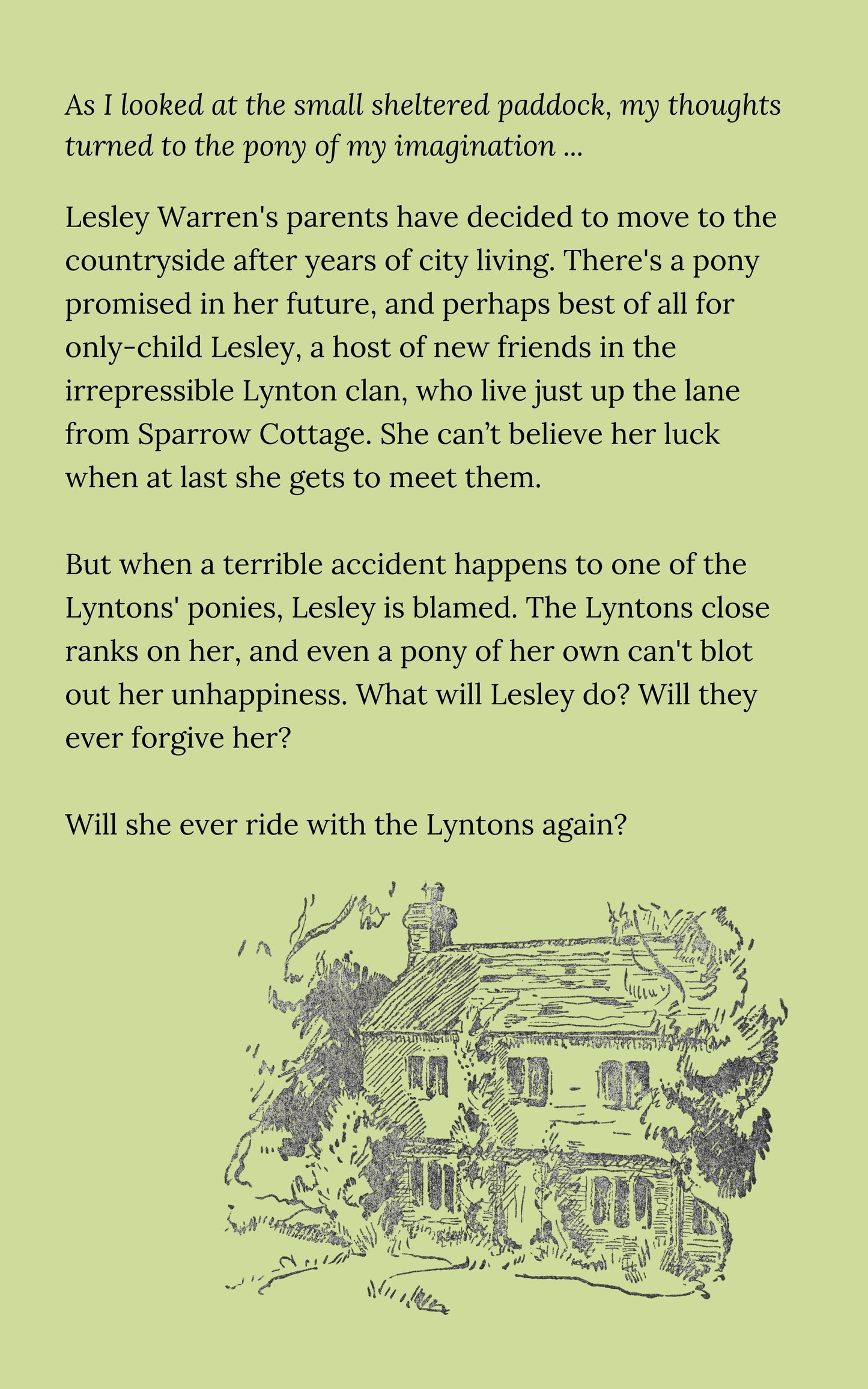
I SHALL NEVER forget my first sight of Sparrow Cottage; the sun shone on the ancient tiles, green here and there with lichen and the passage of the years; a slanting beam of gold lay across the rough path which led through the untended garden to the neat white door; the small windows, pleasing and symmetrical, appeared to smile at the rolling landscape, which, wrapped in the soft greens and browns of autumn, climbed upwards all around to meet at last the blue skies of an Indian summer.
Here, after London, the air was cool and clear; the world silent, apart from an occasional bleat from the sheep grazing the distant pastures or the sad moo of some homely cow waiting to be milked. No reek of petrol, no unseemly blare of angry horns, no sound of bus or train or car reached the ill-cared-for lane which led down into the valley to Sparrow Cottage. But the wide garden gate welcomed us and the oak close by was friendly—shelter from the wind and rain, shade from the sun, a tree to climb, to explore, I decided, noting footholds on the trunk, a useful fork and, high up, a haven of green amongst the leaves.
And now my parents were talking. “You see we will be right away here. No one can get at us, and isn’t the view superb? Have you seen anything like it? Look at those hills, and that line of trees against the horizon!” Daddy was enthusiastic. He’s always enthusiastic about anything new; that’s one of the nicest things about him. He could hardly wait now to get the key in the door, to show us this dream cottage which he had found and which neither Mummy nor I had seen before. I remembered he had been equally excited about our last flat in London—the one we were now about to leave—and I couldn’t understand his enthusiasm then, but now of course I could more than share it.
“And where’s the paddock for Lesley’s pony?” Mummy asked. “You know you promised there was one.”
“Wait a minute, for heaven’s sake,” said Daddy, opening the door at last. “I can’t show you everything at once. Anyway, she can’t have a pony until I get my April royalties and see how well Forget Not Thy Cloak has done.”
“But you promised,” I wailed. “You promised, Daddy. If it only depends on how well your last novel does, I shall never get a pony.”
“You’re not very complimentary,” remarked Daddy.
For a few seconds I was enveloped in gloom. I had been looking forward to that pony for months; the longing had gone hand in hand with my desire to live in the country; and now suddenly the prospect of having one seemed as uncertain as a fine day in midwinter.
But the next moment my mind was distracted by the interior of the cottage. There was a long room with two windows and an open fireplace.
“Here we shall eat, work and amuse ourselves,” said Daddy.
“Let’s call it the living-room,” suggested Mummy. “I do hope we can fit all the books in. I suppose we could have a case built on either side of the fire.”
The other rooms were simply tiny. My bedroom was the only attic, a low long place, roughly whitewashed, with a minute window looking out across those friendly hills towards the sea, which lay some thirty miles beyond. A romantic room, I thought, away from everyone, with only the four steep steps in the wooden staircase leading to it.
“I hope you won’t feel too lonely up here, Lesley, but you can leave your door open at night,” said Mummy. “We shall have to get the decorators in to deal with your walls; they need plastering here and there and distempering all over.”
“My only complaint is that I shan’t be able to hang my pictures,” I told her, looking at the eaves which came right down to the floor, and the slope of the walls.
“Never mind, we’ll give you a bit of the passage,” said Daddy. “Come on, I’ll show you the paddock and the shed which I’ll turn into a stable for Lesley one of these days.”
My hopes rose again. My life is like a see-saw; it rushes up and down from success to disaster, from joy to gloom, from hope to despair. But I suppose everyone’s life is the same to a greater or lesser degree, and, at least, mine is never dull.
As I looked at the small sheltered paddock, my thoughts turned to the pony of my imagination—a breedy type, black as midnight, with bold eyes in a finely cut head; a five-year-old with all his career before him, highly strung, dauntless and kind. There was no one to tell me that such a pony would be entirely unsuitable for me, an unexperienced and too-reckless girl of eleven, to ride.
“You couldn’t have anything better than this, not anywhere, could you, Lesley,” said Daddy, looking to see approval and enthusiasm on my face. “It’s so sheltered with that beautiful beech hedge and those oaks—the noblest trees of all—and, do you see, the water trough is just by the garden so you’ll be able to fill it easily from the kitchen tap.”
“Except when there’s a drought and the well’s empty,” said Mummy, a worried line creasing her high forehead. “That’s my only worry.”
“But darling!” exclaimed Daddy. “How often is there a drought in this rain-soaked country? Once in a blue moon; and then we’ll manage somehow, or move out until the well fills again. Honestly, I shouldn’t waste any time worrying about that.”
“And now the shed; we haven’t seen the shed,” I reminded them. “I love the paddock; it’s perfect. I can just see my pony waiting at the gate for his daily feed.”
“You’ll be able to grow carrots for him in the garden,” said Mummy vaguely.
We looked at the shed: it was brick and rather tumbledown with holes in the roof.
“We’ll have to get the builders in to see to that,” Daddy told us. “But in April, with luck, I can afford it.”
“Oh, thank you,” I said. “Thank you. If only I could think of
some way to earn money. If only I could paint or draw or something.” I remembered a girl at school who designed Christmas cards each year and made pounds.
It seemed sad that I had so little talent myself, but perhaps I could earn something by honest toil, I decided.
“And I forgot to tell you,” said Daddy, “about the wonderful friends for Lesley. You know that handsome grey house at the top of the lane? You must have seen it—the one with the white windows and that beautiful curving lawn, which you remarked on.”
“Yes, I know. Go on,” said Mummy.
“Well, I found out who lives there—a whole family with lots of children and ponies, all ages and all shapes and sizes. They’re called the Lyntons. I don’t know what their father does. I mean I can’t think how he can afford to live right out of the way down here. Perhaps he’s an artist, but then how can he earn enough money to bring up such a family?”
“Perhaps his wife is an heiress,” laughed Mummy. “But I’m so glad you’ve found all that out, because I was a little worried about Lesley getting lonely down here.”
“It’s wonderful,” I said. “I do, do hope they like me.”
“Of course they will like you, as long as you are agreeable and friendly,” said Mummy firmly. “Anyway, if they have ponies you’ll have lots in common, no doubt about that. You must get better at making friends.”
“That’s just what I thought. When the old man at the Stag’s Head told me about the Lyntons I could have cheered. They are our nearest neighbours, too. There’s the empty cottage beyond them, which was too expensive for us, and then the farm and the three cottages housing the farm labourers and their wives. I shall be able to write like mad down here, I feel it deep down in my bones,” said Daddy, gazing happily at the tranquil landscape.
It seemed as though the future was filled with promise for all of us; friends and ponies for me; peace, quiet and beauty for Daddy; and what for Mummy, I wondered suddenly? Well, just the country, I decided, for she had always hated London, the noise, the bustle, the cocktail parties; the necessity to dress properly every day—no faded cotton frocks, no ancient sandals, no darned pullovers were her daily wear in London; somehow she had always felt she must dress tidily in the great metropolis, and yet the habit was alien to her nature.
“I’m going to keep some chickens,” she said now, “in that corner of the garden which is covered with nettles; just six Rhode Island Reds, five hens and a cock.”
“And we must have a dog,” added Daddy. “I haven’t had one since I was eighteen and that’s years and years ago.”
“A spaniel with floppy ears? Or a self-possessed poodle? Or a terrier?” I asked. “Do let’s get one soon.”
“We must think very, very carefully,” Daddy told me. “Spaniels age rather quickly. Poodles are fashionable and I don’t want to be fashionable, and terriers—well let’s think about it later. After all we can’t move in till December, don’t forget.”
“Come on,” said Mummy, taking the key. “We shall have to start back now or we won’t be in London before midnight. It’s a five-hour drive, you know.”
“December seems years and years away, and April is even further. I don’t know how I shall bear my last term at school,” I said, giving a last glance at the white five-barred gate leading into the paddock.
We walked single file up the winding lane, which was sadly overgrown with brambles. I loitered here and there, to my parents’ annoyance, to pick blackberries. At the top we clambered into the car, a pre-war affair, rather battered but fast and comfortable.
Evening was in the air; the sunshine pale now; the hills drifting into slumber. Somewhere an owl, perched high in a nearby tree, hooted eerily of the dangers of the night. Softly the thick grass at the roadside squelched beneath our tyres, as our car slid forward—the sole machine within sight or earshot. And here was the Lynton’s house: a charming grey place, with fields around and that superb sweep of lawn curving downwards to meet the rose-decked ha-ha, which parted the garden from lush meadowland beyond.
Yes, there were ponies in the fields and stables in the yard, and somewhere I caught the glimpse of a child—a small boy with straw-coloured hair, wearing jeans and grasping a pitchfork in his hand. My friends of the future, I thought, lots of them, all shapes and sizes. They’ll help me choose a pony for myself. I shall have them all to tea. We shall play hide and seek and murders; we shall toboggan together in the snow; we’ll organise races for our dogs; and, if I hunt, we shall all hack to the meet together. The Lyntons would stop me missing the friends I was leaving behind in London—Mary, Susan, John.
The car climbed up and up and up; until at last we had reached the crest of Letcombe hill, and looking back we could see far down in the valley, a red dot wrapped now in the mists of evening, with two chimneys, with a wide garden gate and a giant oak close by.
“Look,” said Daddy. “There she is—Sparrow Cottage.”
“Our home of the future, how tiny it seems,” laughed Mummy.
“If only December would come now,” I said.
And then we pushed onwards driving into the night, driving back to civilisation, driving back to the smoke-grimed London which had been my home for so long.
Who's in the book?
Who's in the book?
PEOPLE
Lesley Warren, Mr Adrian and Mrs Warren, Robin, Mr and Mrs Downs, Mr George Patterson
The Lyntons:
Jon, Paulla, Gillian, Donald, Annette; Frank Lynton, Mrs Lynton
HORSES
Leary, Firelight, Buccaneer, Jingle, Jangle, Mercury, Firelight, Cloudy
Other titles published as
Other titles published as
Series order
Series order